
Money Muling: AML's Fastest Growing Challenge
Explore how money muling has become AML's fastest growing challenge, with criminals exploiting digital platforms and vulnerable individuals to move illicit funds while evading detection.
Money Muling: AML's Fastest Growing Challenge
From traditional cash-based operations to the deployment of technology, money muling continues to pose as a global threat to anti-money laundering (AML) programs. A good number of money mules have slipped through traditional monitoring systems without being detected, thus facilitating criminal activities. Even the rise of online banking, cryptocurrency, and instant payment platforms has made it easier for criminal networks to recruit unsuspecting individuals to move illegal funds across borders. These transactions are often camouflaged as legitimate payments, making it more challenging for compliance teams to identify and stop them in real time.
Table of Content
- What is Money Muling?
- Who Is A Money Mule?
- How Criminals Recruit Money Mules
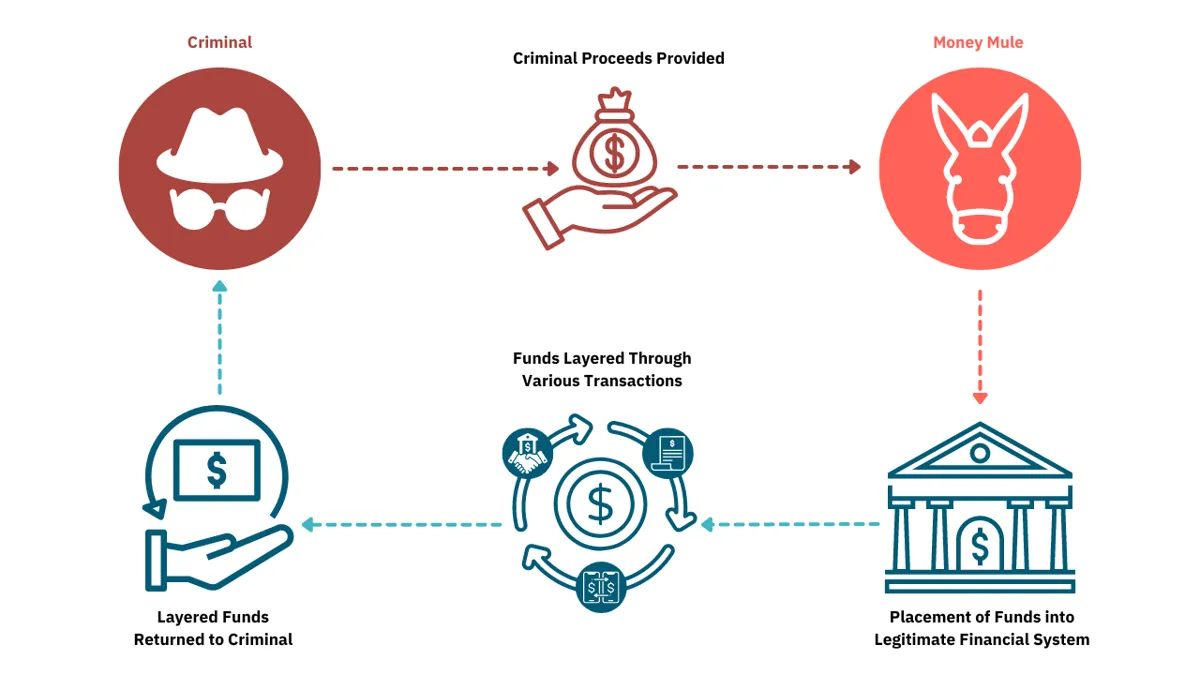
- The Money Muling Process
- Digitalization In Muling Operations
- Consequences of Being A Money Mule
- Red Flags and Warning Signs of Money Muling Activities
- Industry Best Practices for Money Muling Prevention
- FAQ
What is Money Muling?
Money muling is the process of recruiting individuals (unwilling and willing) to transfer illegally obtained funds (usually from drug deals, human trafficking and fraud) through their personal accounts or cash withdrawal of same to give to a third party, in exchange for a commission or a specific amount of money which is generally too good to pass off. Invariably, the money is laundered and provides legitimacy for the proceeds of the crime. When it comes to financial institutions, money mulling is s serious challenge in compliance. Unlike traditional money laundering schemes that usually involve noticeable red flags, muling operations intentionally exploit the normal banking behaviour of apparently legitimate customers i.e. they possess a clean banking history, normal transaction patterns, and legitimate account documentation. This prevents the trigger of predictable AML alerts.
According to Europol, several operational phases in June, October and November 2023, identified 10,759 money mules and 474 recruiters (herders), which led to the arrest of 1,013 individuals globally. Although € 100 million was reported to have been lost to money muling operations, € 32 million which would have towed the loss path was prevented.
On March 1st, 2024, gov.uk reported that 'Cifas estimates that there were 37,000 bank accounts which demonstrated behaviour associated with muling in 2023. Approximately £10 billion of illegal money is laundered each year in the UK, according to estimates from the National Crime Agency (NCA). Around 23% of money mules are under 21, and 65% are under 30. They are often groomed by criminal gangs, who offer them the prospect of making easy money. Once they are in the system, the gangs will then coerce them into committing further offending, including through blackmail, debt bondage and sextortion'
This is a worrisome trend and sadly a good number of people have been caught in the web of these criminal herders.
Who Is A Money Mule?
A money mule is an individual who receives illegally obtained funds in their account, then moves same to another location under the directive of the criminal herder (recruiter). It generally involves both willing and unwilling participants. Willing participants knowingly facilitate money laundering in exchange for easy money with minimal effort. They are aware of the illegal nature of their activities having been motivated by financial incentives usually due to desperation, and sometimes even coercion. Unwilling participants on the other hand, carry out the transfer process believing same is legitimate as a result of being employed remotely to process for instance, company's payments or help online romantic interest transfer funds due to banking restrictions in their country. They may appear to be genuinely confused about account activities, provide detailed made-up explanations they believe to be true, or express concern about unusual transactions they don't understand. Bottom line is that they are used to move funds around while the criminal masterminds remain in the shadows.
How Criminals Recruit Money Mules
Recruiters, also known as herders, use social media platforms who deploy sophisticated targeting algorithms to identify potential victims. These campaigns often hide under the cover-up of legitimate employment opportunities that promise flexible remote work positions with attractive compensation for minimal skills or no experience requirements. They post jobs on social media, messaging apps, pop up ads, online job fora, e-mails, predominantly targeting students, the unemployed, new Immigrants and those seeking additional income. In fact, these deceitful listings appear on legitimate job boards and provide real company descriptions, cloned professional-looking websites, and detailed job responsibilities. The positions on offer generally involve 'processing payments,' 'facilitating international transfers,' or 'managing client accounts'.
For romance scams, criminals invest weeks and even months building close relationships with targets before presenting financial requests. The progression generally follows a pattern that is predictable; initiate contact through a dating platform, gain fast emotional connection with target, raise claims of travel or business complications that is preventing direct financial access, and then request target to receive and forward funds on his/her behalf.
Criminals leverage personal information gathered from social media profiles, data breaches, and public records to create an approach that is highly personalized and exploit specific vulnerabilities such as recent job loss, financial hardship, relationship struggles, or cultural factors that might make individuals more vulnerable to being recruited.
The Money Muling Process
Operations via money muling is designed to maximize profit by criminals while minimizing the risk of being detected. This dark process begins with careful recruitment of ideal candidates, followed by preparation of accounts, injection of funds, implementation of fast transfer and finally, extracting cash or converting to assets that are untraceable. Let's run through this process.
At the recruitment phase, potential mules are identified and evaluated based on their vulnerability, banking profile, and likelihood of cooperation. Criminal handlers assess the candidates' financial situation, use of technology and level of mental susceptibility in order to determine their suitability for a definite operation. Now the evaluation process may go on for several weeks, with criminals slowly building trust and testing the level of target's compliance through small requests prior to proposing larger financial transactions.
Criminals work to establish legitimacy for upcoming transactions at the account preparation stage. Potential mules are asked to increase their account activity, start positive banking relationships, or even provide documentation that supports cover stories for unusual transactions. In fact, some operations involve creating fake employment documentation, establishing shell companies, or developing multifaceted narratives that explain the origin and purpose of incoming funds. When this has been done, funds are then injected wherein criminal proceeds are deposited into the mules' accounts through different methods ranging from wire transfers, check deposits, to peer-to-peer payments, or even cash deposits. The method of injection and timing are cautiously planned to reduce the risk of detection while maximizing the amount that can be moved through each account. Criminals often use numerous injection points at the same time, distributing funds across different mule accounts to avoid threshold limits and reduce the impact of the closure of an account.
When that has been successfully done, the transfer which moves funds from mule accounts to the destination directed by criminals via domestic or international transfers, cryptocurrency purchases, or conversion to other monetary instruments, or cash withdrawal takes place. In fact, this stage generally occurs within a short time for e.g. hours after funds have been injected, in order to lessen exposure time and reduce the likelihood of reversal of transactions or freezing of accounts.
Digitalization In Muling Operations
The integration of cryptocurrency has created new possibilities for injection of funds and extraction phases in muling operations. Criminals can convert traditional currency to digital assets through mules' accounts, then transfer those assets across jurisdictions with minimal trace. The nature of cryptocurrency transactions, and the technical complexity of blockchain analysis, provides these criminals with greater security operations while complicating investigation efforts by law enforcement and financial institutions.
Mobile payment platforms have become preferred tools for both recruitment and fund movement due to their ease of use, widespread adoption, and often limited AML controls compared to traditional banking systems. Peer-to-peer payment applications allow criminals to move funds quickly between multiple accounts while preserving the appearance of normal consumer transactions.
Cross-border digital transfers have been simplified through fintech platforms that offer international money movement services with reduced documentation requirements compared to traditional correspondent banking relationships. These platforms often target underbanked populations and emphasize convenience over all-inclusive due diligence, thus creating opportunities for criminals to exploit the system while making detection more challenging for traditional AML monitoring systems.
Consequences of Being A Money Mule
An individual whether he/she was unaware of the crime or not (money laundering, fraud or aiding and abetting financial crime) can be sentenced to 14 years imprisonment. This criminal record can lead to travel bans and denial of visas particularly in countries with strict financial crime laws, such as the UK. To get a job now becomes a problem and it can have an impact on their credit scores which invariably makes it difficult to access loans, or mortgages. Besides once in, it becomes hard to get out as these criminals resort to threats, violence and blackmail to ensure victims continue to be their money mules.
Red Flags and Warning Signs of Money Muling Activities
Patterns in Account Performance
Unlike apparent money laundering indicators such as deposits of large cash or transactions with known high-risk jurisdictions, muling operations purposely imitate normal banking behaviour while exhibiting specific characteristics that trained analysts can identify. Movement of funds rapidly with minimal account history is one of the key indicators of muling activity. Speed is prioritized by criminals during operations to reduce exposure time and reduce the likelihood of transactions being reversed or the freezing of accounts. Hence, funds usually remain in the mule accounts for hours or days instead of weeks or months. Sometimes it can be immediately transferred elsewhere habitually without the normal processing delays that is associated with legitimate business or personal transactions.
Money muling operations often require funds to be transferred across international borders or to domestic locations that have no apparent relationship to the mule's residence, employment, or family connections. These patterns become more suspicious when they involve multiple destinations, which invokes the suggestion that the funds are being systematically being distributed which is uncharacteristic of personal transactions.
When there's high-volume, round-number transfers, this usually indicates a coordination of criminal activities instead of the usual organic activity. Personal transactions that are legitimate generally involve irregular amounts that reflect actual bills, purchases, or financial needs, while criminal operations often use round numbers for simplicity and standardization. Additionally, the volume of activity may be dramatically inconsistent with the account holder's known sources of income or historical transaction patterns, thus suggesting sources of funds as being external. The sequence in timing of transactions can disclose coordination of criminal activities especially when multiple transfers occur in fast succession or follow suspicious deposit patterns.
Customer's Profile
Inconsistent personal information represents a significant red flag, particularly when customers provide conflicting details about employment, residence, or financial circumstances during different interactions with the financial institution. Minor inconsistencies may reflect normal human error or changing circumstances, however, systematic discrepancies actually suggest either a deliberate deception or confusion resulting from following instructions given by criminal handlers. This may manifest as conflicting explanations for source of funds, inconsistent information about employment or varying descriptions of transaction purposes.
Unwilling mules may genuinely lack understanding of the transactions occurring in their accounts, provide explanations that are inconsistent with the actual transaction patterns or demonstrate confusion about the source, purpose, or destination of funds. This is different from the willing mules who have detailed knowledge that legitimate account holders typically possess about their own financial activities.
Behavioural changes during the customer relationship can signal the transition from legitimate account usage to criminal exploitation. Customers who suddenly begin receiving large transfers or express confusion about account's activities or seek help with unfamiliar transaction types may be experiencing the early stages of money mule recruitment or may have recently become aware of criminal activity in their accounts.
Transaction Monitoring Alerts
Modern AML transaction monitoring systems must be able to spot subtle patterns typical of money muling operations while reducing false positives that could overwhelm investigation resources or negatively impact legitimate customers. Money muling operations typically exhibit very short timeframes between receiving of funds and transfer, and the frequency of transactions may suddenly increase dramatically when compared to the historical account especially with regards to international transfers or specific recipient types.
Structured deposits and withdrawals can also indicate attempts to avoid the reporting thresholds or detection limits, though criminal organizations have become techier to avoid obvious structuring patterns. Modern structuring may involve coordinating activities across multiple accounts or institutions, irregular timing patterns designed to avoid detection algorithms, or the use of amounts that vary slightly from round numbers while still serving their operational needs.
Cross-border transfer patterns require particular attention and suspicious patterns may include transfers to jurisdictions with limited AML oversight, unusual routing through multiple correspondent banks, or destinations that lack any logical connection to the customer's profile or stated transaction purpose.
The integration of multiple alert types can provide more reliable detection than individual indicators, particularly when different monitoring systems identify related suspicious activities within shortened timeframes. For example, a customer who receives unusual wire transfers, immediately attempts to purchase cryptocurrency, and then conducts international transfers, may be participating in a muling operation that exploits many payment channels to obscure the final destination of criminal proceeds.
Industry Best Practices for Money Muling Prevention
Deployment of Prevention Strategies
Preventing money muling operations requires a combination of comprehensive customer due diligence, proactive risk assessment, and ongoing monitoring throughout the relationship with the customer. Enhanced customer due diligence is the bed rock of effective prevention, which goes beyond standard identity verification to include behavioural assessment, risk profiling, and ongoing relationship monitoring. This enhanced approach involves collecting additional information about customers' employment, income sources, and expected account usage patterns, then monitoring actual activity for deviations that might indicate criminal exploitation. Financial institutions need to implement risk-scoring methods that consider different factors such as customer demographics, account features, transaction patterns, and external risk indicators to identify accounts with high money muling potential.
Procedures for opening an account should be designed to spot and discourage recruitment of both willing and unwilling mules. This includes implementing verification processes that confirm employment claims, validation of residential addresses, and carrying out a consistency assessment with the information that was provided. Some institutions have found success with additional authentication steps for high-risk customer profiles, such as requiring in-person visits, providing multiple forms of documentation, or implementing waiting periods before enabling full functionality of account.
It is worthy of note that front-line employees who interact with customers during the opening of accounts and ongoing service delivery are uniquely positioned to identify potential money mules through observation of customers' behaviour, questions, and concerns. Thus, they need to undergo training to know how to spot them and know the right steps to take post identification.
Furthermore, educating customers can help to reduce recruitment of unwilling mules via increasing public awareness of common recruitment techniques and warning signs of being criminally exploited. Vulnerable targets such as students, job seekers, and even the aged, should be enlightened through suitable communication channels with the right message that stresses the legal risks and personal consequences of being a money mule.
Advanced Detection Strategies for Financial Institutions
Optimizing detection of money muling operations requires non-stop improvement of monitoring systems, investigation processes and analytical techniques to keep stride with on-going criminal methods. There should be regular review of alert generation patterns, investigation outcomes, and missed case analysis to identify opportunities for improvement. Advanced institutions implement machine learning techniques that can spot complex patterns not easily captured by traditional rule-based systems, however, it requires careful validation to ensure unintended bias or discrimination is not introduced.
Improvement of Investigation workflow can meaningfully improve the effectiveness of detection by ensuring that potential money mule cases receive appropriate attention and analysis. This includes implementing case prioritization systems that focus investigative resources on the highest-risk alerts, developing standardized investigation procedures that ensure consistent handling of cases and creating feedback mechanisms that allow investigators to share insights about emergent criminal techniques, with operators monitoring the system.
For effective detection, visibility across traditional banking, digital payments, cryptocurrency transactions, and other financial services is a must, in order to identify coordinated criminal activities that span across many platforms. This may require improved data sharing arrangements, integration of monitoring systems, or joint investigation approaches with other financial service providers. Real-time detection capabilities are becoming essential as criminal operations accelerate their timelines to minimize exposure and maximize success rates. Traditional batch-processing approaches to transaction monitoring may be insufficient to detect and respond to money muling operations that move funds within hours of receipt. Institutions should evaluate streaming analytics, generate real-time alert and automate response capabilities that can identify and potentially disrupt criminal activities before they are completed.
Effective Response Protocols When Money Muling Is Detected
The most successful financial institutions develop comprehensive response frameworks that address different scenarios and provide clear guidance for members of staff at all levels. When it comes to procedures for closing accounts, it must be implemented carefully so as to avoid alerting criminals of detection while protecting the institution and the potentially victimized customers. Although Immediate closure of account may be appropriate for obvious criminal activity, but cases involving potentially unwilling mules may benefit from gradual responses that include contacting the customer, restricting transactions or higher level of monitoring before closing the account. Financial Institutions should develop clear criteria for different response levels and ensure that both risk mitigation and customer protection factors have been taken into account before reaching the decision to close the accounts.
Furthermore, there should be clear protocols for when and how to contact law enforcement agencies, what sort of information should be shared under what circumstance and how to keep cooperating with them throughout the investigation. Some institutions have found premium value in developing relationships with specialized financial crimes units that have expertise in investigating money muling operations.
It is important for Institutions to implement robust documentation procedures that capture the full scope of suspicious activities, customer interactions, and investigative findings while ensuring compliance with all relevant reporting obligations. This documentation serves not only as a regulatory requirement but also provides valuable intelligence for detection and prevention efforts in the future.
In conclusion, money muling exploits our vulnerability as humans and the gaps in AML systems. However, through the combination of comprehensive transaction monitoring, public awareness campaigns, and international collaboration between financial institutions and also law enforcement agencies, muling operations will be reduced significantly.
You can join the fight against money laundering by learning in-depth about AML/KYC and start on this career path to success.
Enrol now at titanscareers.com
Read more: Money Mule: How Criminals Target You (How to Stop Them Now)
FAQ
What is money muling and how does it work? Money muling is the process where criminals recruit individuals to transfer illegally obtained funds through their personal bank accounts. The process involves recruitment, account preparation, fund injection, and rapid transfer to hide the criminal origin of the money.
How do criminals recruit money mules? Criminals use social media platforms, messaging apps, fake job postings, romance scams, and target vulnerable populations like students, unemployed individuals, the aged and new immigrants. They often pose as legitimate employers offering remote work opportunities.
What are the warning signs that someone might be a money mule? Key red flags include rapid movement of funds, high-volume round-number transfers, inconsistent personal information, confusion about account activities, and transactions to unrelated international destinations.
Can someone unknowingly become a money mule? Yes, many money mules are unwilling participants who believe they're performing legitimate work. They may think they're processing company payments or helping someone with banking restrictions.
What are the legal consequences of being a money mule? Money muling is illegal and can result in criminal charges, even for unwilling participants. Consequences may include fine, imprisonment, and permanent damage to credit and banking relationships.
How do financial institutions detect money muling activities? Banks use transaction monitoring systems, customer behaviour analysis, enhanced due diligence procedures, and machine learning algorithms to identify suspicious patterns consistent with money muling operations.
What should I do if I suspect money muling activity? Report suspicious activities to your financial institution immediately, contact law enforcement if necessary, and avoid participating in any questionable financial transactions, even if they seem legitimate.
How has technology changed money muling operations? Criminals now use cryptocurrency, mobile payment platforms, and digital transfer services to move funds more quickly and with less trace, making detection more challenging for traditional monitoring systems.